Perfume leakage is one of the most common yet misunderstood issues in the fragrance industry. A leaking bottle not only leads to product loss, but also damages the user experience, creates safety risks during transport, and harms a brand’s perceived quality. For perfume manufacturers and brands, preventing leakage is one of the most critical aspects of packaging engineering—and surprisingly, it is also one of the most complex.
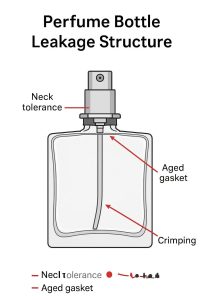
Leakage does not happen randomly. It is always the result of systematic engineering factors, including:
glass bottle manufacturing tolerances
sealing structure design
sprayer and pump construction
gasket material behavior
crimping/locking force
alcohol–plastic compatibility
environmental pressure changes
transportation vibration
quality control standards
In this long-form technical guide, we break down every component that affects perfume bottle leakage. By the time you finish reading, you will understand:
why perfumes leak even when bottles look perfect,
what really happens inside the sealing system,
how manufacturers test leakage,
and how to build a truly leak-proof perfume packaging.
This article is written based on deep industry practice—from glass factories, mold workshops, CNC metal pump manufacturers, gasket suppliers, to fragrance filling lines. It is meant for brands, packaging engineers, and buyers who want a comprehensive technical understanding.
1. Understanding the Complete Perfume Packaging System
A perfume bottle is not just a bottle. It is an integrated sealing system composed of:
Glass bottle body
Bottle neck + inner sealing wall
Pump sprayer (crimp or screw type)
Gasket (PE, rubber, or composite)
Crimping / screwing force
Outer collar / metal shell
Cap and fit tension
Each one of these components requires strict manufacturing precision. Even a 0.1–0.2 mm deviation may weaken sealing performance, resulting in:
slow seepage
evaporation loss
leakage during transportation
leakage after months of storage
This is why reliable perfume packaging requires both precise craftsmanship and strict quality control.
2. Why Do Perfume Bottles Leak? 12 Real Technical Causes
Leakage usually comes from one of the following engineering causes:
Cause 1: Bottle Neck Tolerance Out of Specification
Most perfume bottles follow GCMI or FEA neck standards (e.g., FEA15, FEA18, FEA20).
If glass production has:
unstable temperature
improper cooling rate
uneven mold surface
misaligned mold seams
…the result will be:
too large or too small neck diameter
oval neck instead of round
rough sealing surface
uneven neck thickness
A 0.1–0.3 mm deviation is enough to destroy sealing.
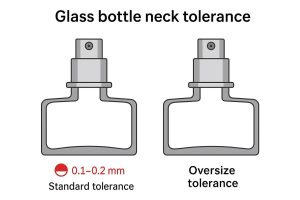
Why?
Because the pump relies on uniform compression between the gasket and the inner wall of the neck.
If the neck is oval, the gasket cannot achieve uniform pressure → micro gaps → leakage.
Cause 2: Rough Sealing Surface
The top rim (“land area”) of the bottle must be:
flat
smooth
not wavy
no micro dents
Roughness above Ra 0.8 can cut into the gasket, causing long-term leakage.
Cause 3: Incorrect Pump Crimping (FEA Crimp Pumps)
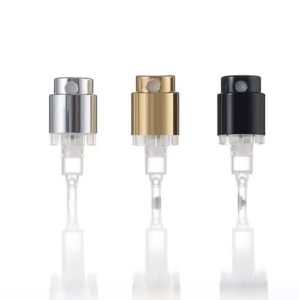
Crimping issues are the #1 cause of industrial leakage complaints.
Bad crimping includes:
crimping too loose → insufficient pressure
crimping too tight → gasket damaged
uneven crimping → one side loose, one side tight
deformed aluminum collar → micro gaps
improper head height → locking point wrong
Proper crimping requires:
calibrated crimping machines
consistent pressure
tests every 30 minutes
experienced operators
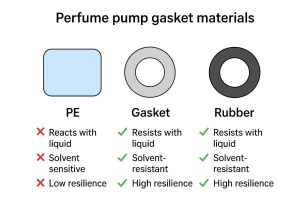
Cause 4: Weak Gasket Elasticity
The gasket is the heart of the sealing system.
Common materials:
|
Material |
Pros | Cons |
| PE (polyethylene) | low cost, good resilience | Absorbs alcohol over time |
| Rubber | flexible, strong seal | aging, hardening |
| TPE / composite | best sealing performance | slightly higher cost |
Cause 5: Pump Tube Too Long
If the dip tube touches the bottom:
vibration during shipping pushes the tube upward
this lifts the entire pump
creating invisible gaps around the gasket
This is one of the most common “mysterious leaks” that brands never detect until after shipment.
Cause 6: Excess Filling Volume / Expansion
Perfumes contain alcohol. Alcohol expands under heat:
transport in summer
storage in containers
sunlight exposure
If the filling level is too high (>90%), expansion pressure rises → leakage.
Cause 7: Incorrect Cap Fit
The cap has no sealing function, BUT:
A cap that is too tight can pull the pump upward during removal.
If the pump rises even 0.1 mm → the seal breaks → leakage.
Cause 8: Compatibility Problems Between Formula and Materials
Some perfume bases or oils can:
dissolve gaskets
soften pump chambers
expand plastic components
corrode aluminum over time
This leads to long-term leakage—even if initial sealing was perfect.
Cause 9: Transportation Vibration
Long-distance transport (UPS, DHL, container shipping) may cause:
pump loosening
gasket displacement
micro-movement of crimp ring
Testing with vibration machines is essential to prevent this.
Cause 10: Pressure Change in Air Transport
Air cargo undergoes pressure changes, especially:
unpressurized cargo areas
rapid altitude change
Perfume can leak through micro-gaps that would remain sealed under normal atmospheric pressure.
Cause 11: Capillary Seepage Evaporation
Some leaks are not visible as liquid. Instead:
alcohol evaporates
fragrance oil remains
bottle becomes sticky
scent weakens
This is “capillary seepage”—a slow leakage caused by micro gaps.
Cause 12: Poor Quality Control
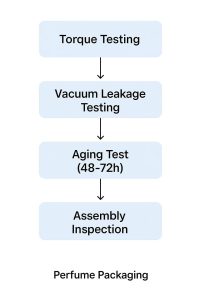
Factories without strict QC cause:
inconsistent crimping
mixed pump batches
improper gasket sourcing
no vacuum leak test
no aging test
Even with perfect materials, bad QC = guaranteed leakage.
3. How Manufacturers Test Perfume Leakage
Professional perfume factories perform:
1. Vacuum Leakage Test
Simulates pressure changes → checks for micro gaps.
2. Inverted 24–48h Storage
Tests if any leakage occurs when the bottle is upside-down.
3. Vibration Test
Simulates transportation → pump loosening test.
4. Temperature Aging Test
From −10°C to 50°C → tests expansion pressure.
5. Torque and Crimp Strength Test
Ensures pump is properly locked.
6. Alcohol Compatibility Test (ASTM Standard)
Gasket elasticity after soaking in alcohol.
With all tests combined, a manufacturer can reach:
0.1–0.3% leakage tolerance (industry excellence)
1–3% leakage tolerance (average factories)
4. How to Prevent Perfume Leakage: Complete Checklist
For Glass Manufacturers
ensure mold alignment
maintain neck tolerance <0.2 mm
polish inner sealing wall
implement automated inspection machines
For Pump Manufacturers
use advanced crimping heads
ensure gasket hardness consistency
test each lot with alcohol
maintain tube length ±1 mm
For Fragrance Brands
avoid overfilling
perform compatibility tests
store away from heat
do random QC on each production batch
5. Conclusion
Perfume leakage is not a simple defect—it is the result of a complex chain of engineering issues. Achieving a 100% leak-proof product requires:
precise craftsmanship
strict QC
proper material selection
correct packaging design
experienced suppliers
If you work with a professional perfume packaging manufacturer with strict testing standards, leakage becomes extremely rare and fully controllable